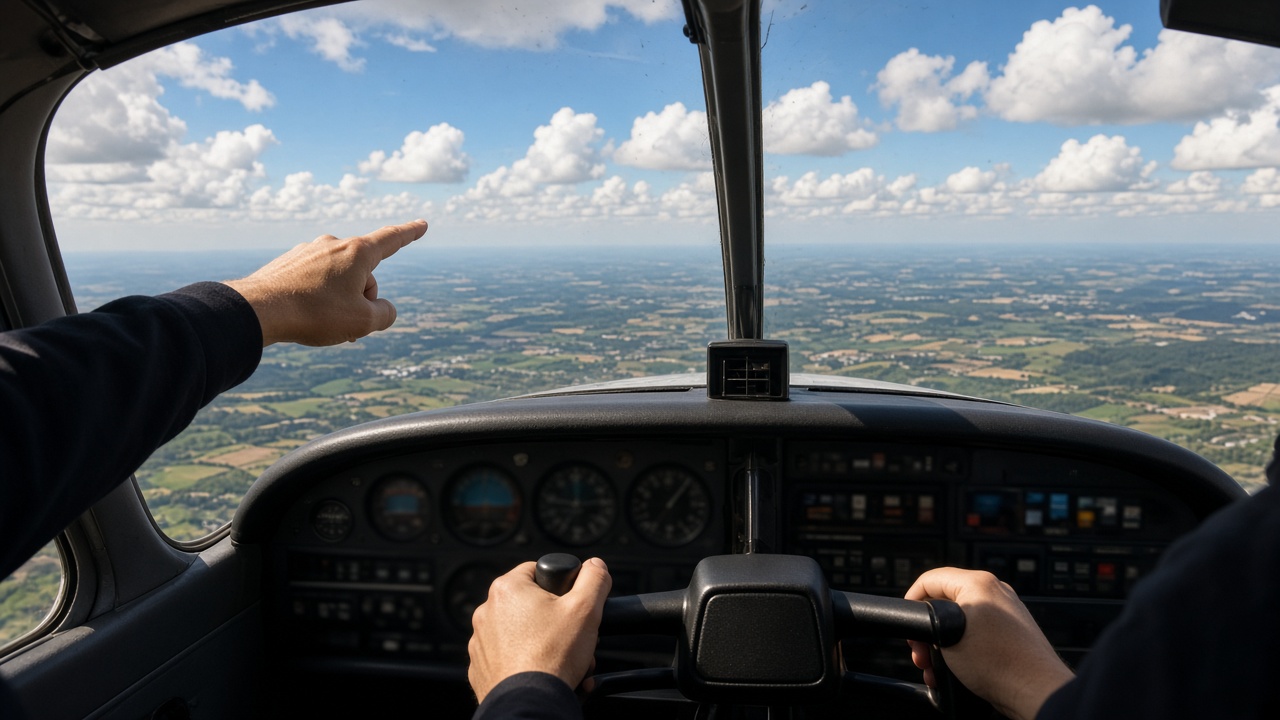
Everything aviation, starting with how to become a pilot.
Guides on the path to a licence, a directory of flight schools, and simple tools for training. Written carefully: uncertain figures are marked, and nothing here is a quote from a school or a regulator.
Licence types, the UK CAA, cost, the medical, and how to question a school. EASA first, with a short FAA comparison. The pilot training roadmap puts that order on one page.
02
Look at schools
Browse 32 listings by country and licence type. Sample rows are marked clearly; published submissions are not recommendations.
03
Use the tools
Great-circle distance and flight time, unit conversion, and a crosswind component. Arithmetic for training, not navigation.
Most people start by deciding whether they want to fly for themselves or as a career, then train under one authority’s rules. In EASA states that means a light, private, or professional aeroplane licence, a medical, theory exams, flight training, and a skill test.
These four names are the main aeroplane licences in the EASA system. A licence is the permission to act as a pilot at a certain level. A rating is the extra permission to use that licence in a particular aircraft, at night, or in cloud.
There is no honest single price for learning to fly. A useful quote lists the hours it assumes, the aircraft, what is excluded, and what happens if you need more time. This page lists the pieces. It does not invent a total.
You need a medical certificate that matches the licence. In the EASA system that is an LAPL medical, a Class 2, or a Class 1. Book it before you pay for a long course. This page is not medical advice and it does not list who will pass.
A useful school is one approved for the licence you want, in the state that will issue it, with aircraft that actually fly and a contract you can leave. Use the questions here on any organisation, including the ones in our directory.
The UK Civil Aviation Authority issues its own pilot licences. They use familiar names, and they are not EASA licences. Since October 2025 the UK no longer issues new LAPL(A)s, and its PPL hour minimum now differs from EASA’s.
Airline transport theory is a set of examined subject groups, not one exam. The list below is the commonly published EASA aeroplane syllabus. The number of papers, the pass mark, and the time limit on a sitting belong to the authority that will examine you.
A night rating and an instrument rating are privileges added to a licence. Neither one is a licence, and neither one is included automatically in a basic private course. The hour figures depend on which rating, which authority, and what experience you already have.
A discovery flight, also called a trial lesson or an air-experience flight, is an hour or so in a training aircraft with an instructor. It is a way to see if you like it. It is not a licence, a medical, or a promise that a later hour will be credited.
A career in flying is not one job. Airline, cargo, instruction, corporate, and helicopter work share some training and then diverge. The licence category you start with, aeroplane or helicopter, is not something you swap later for free.
Integrated training is one approved full-time course. Modular training is the same licences and ratings taken as separate blocks. Neither one issues the ATPL on the day you finish, and neither one has a price this site will invent.
There is no regulation that says a pilot is trained in a fixed number of months. Minimum flight time is not a timetable. Weather, aircraft, money, and how often you fly decide the calendar.
Microlight and light-sport flying is real flying in a lighter aircraft, under national rules that are not the same as an EASA or UK PPL. It can be the right first licence for that aircraft. It is the wrong course if the goal is an airliner.
A licence is permission to fly. A job is an employer deciding to hire you. Airline hiring moves with the market. Instructor, survey, and freight work are common first paid seats, and none of them is guaranteed.
This page is for someone sitting in an airline seat, not for someone training to be a pilot. It describes the ordinary controls around a transport flight. It is not medical advice, and it does not pretend a fear will switch off because you read it.
A pilot medical is an examination for a certificate, not a promise that you will pass and not a treatment. Class 1, Class 2, and the LAPL medical are different certificates. The tests on the day depend on the class, your history, and the rule in force.
A METAR is a routine observation. A TAF is a forecast for a period. They are written in a compact code. This page shows the shape of that code with an invented example. It is not the weather, and it is not a briefing.
Radiotelephony is a small shared vocabulary so that pilots and controllers hear the same instruction. English is the usual language of international flights. A club frequency may use the local language. The exam and any language endorsement are state rules, not a vibe.